Psalm 33 is short and sweet, and so, I feel this exegetical sketch will be, as well!
Psalm 133 is a part of the collection of the Songs of Ascents (Ps. 120-134), which share a theme of Zion as a place of blessing (Mays 412). McCann points out that the "Songs of Ascents were used as a sort of hymnal as families made a pilgrimage to Jerusalem and returned home" (Psalms for Preaching and Worship 344). Thus, it is easy to imagine the setting for this Psalm as a gathering of faithful pilgrims, brought together by their common destination and bound by their experiences of God in their midst. Indeed, Psalm 133 could actually function as a comment on the Songs of Ascents--a momentary aside of a pilgrim to his neighbor about how wonderful it is to be singing with others.
McCann (343-345) and Mays (412-414) do a good job of explaining the references and allusions present in this short poem, so I will not reiterate those. However, I do want to propose an alternate reading of vs. 3b: "For there the Lord ordained his blessing, life evermore." Though based on its context as a Psalm of Ascents and on the logic of the poem, "there" most likely refers to the actual place of Zion, I wonder how the interpretation shifts if we assume the "there" to be family instead. What if God ordains God's blessing within the family of God?
This would beg the question--who is the family of God? The Psalms themselves provide answers enough--all creation is the family of God, and it is in our relationships with our fellow human and creation that we do justice and act righteously. If, as McCann said during class, that God's intent for the world is justice and righteousness, then wouldn't it make sense that when that work is being done--work that binds strangers together as family--God annoints those present?
Psalm 133 makes me consider what experiences are like "pilgrim" experiences for us? When might it be appropriate to utilize this Psalm? Limburg tells the story of teaching it at youth camps and retreats. Indeed, these are liminal experiences. I also could see utilizing them during a mission trip, or even as a greeting during weekly worship. Further, it could be a prayer of stretching into new places to meet new people as a reminder of the scope of God's kingdom.
Showing posts with label images. Show all posts
Monday, December 9, 2013
Sunday, December 1, 2013
Psalm 24--Exegetical Thoughts
Though McCann discusses the recent shift to discussing Psalm 24 in its unity (72), I do find Mays' (120-122) and Limburg's treatment of the three sections of the Psalm to be helpful in orienting ourselves (76-78). The first section affirms God's sovereign reign over the Earth. And where does this power originate from? Well, from God's creative works. Again, saying that God is the owner of the Earth is a countercultural statement for us today, when humanity certainly acts as if it owns the place.
The second section identifies exactly where God is in the world and how one might get there oneself. God isn't a long-distance landlord, who owns property in one place, and dwells in another. No, this Psalm asserts that is present in the earth at the hill of the Lord. It is the righteous who find God there. It's important to note that approaching the hill has less to do with ritual cleanliness than it does with ethical living--with doing justice and righteousness in the world (Mays 121). Here, I am particularly attracted to Mays' understanding of the transaction that happens on the hill: "The creator gives life and relationship in the first place, but it is those who respond by practicing rightness in living who receive a renewal and confirmation by God. They keep the circular movement initiated by God unbroken" (122). It is the righteous who gain access to the hill, and they are blessed with righteousness by God upon arrival. To me, this seems to be a description of God's gracious action in action, and corresponds with a Wesleyan understanding of grace: God's prevenient grace is available to all (as God is the creator), God invites all to journey in a path of sanctifying grace ("the way of the righteous" Ps. 1), and God's justifying grace further blesses those who do travel that path.
In this way, I see these first two movements of Psalm 24 as deeply connected to Psalm 1. They describe where that path of the righteous leads--to the hill of God, for further encounter with God. But it is not for the sole purpose of staying up on the hill with God, but rather is for the purpose of being able to continue in the path of the righteous. In this way, encounters with God are not a one-time event, but are rather a regular pilgrimage those wanderers in the way make through the course of their lives.
![]() |
| By Daniel Dew |
LeMon helps us to imagine Psalm 24 as the liturgy for "the procession of the ark of the covenant into Israel's central shirine" (105). McCann helps us to see the theological procession that takes place as one proceeds on the path of righteousness to ascend God's hill. And Mays helps us to see the procession as an Advent event, as our pilgrimage is a personal one to the meet Christ (Preaching 154). Each interpretation helps us to understand that this is not a one-time, ancient-world procession. Rather, it is an ongoing procession that we can take part in as we strive to walk in the way of the righteous.
Tuesday, November 19, 2013
Psalm 104--Worship Resources
Music:
UMH: God of the Sparrow, God of the Whale, #122
UMH: This Is My Father's World, #144
UMH: All Creatures of Our God and King, #62
UMH: All Things Bright and Beautiful, #147
UMH: For the Beauty of the Earth, #92
FWS: Bless the Lord, #2013
All of Us Belong--Richard Bruxvoort-Colligan
Prayer:
God, whose fingers sculpt sun and moon
and curl the baby's ear;
Spirit, brooding over chaos
before the naming of day;
Savior, sending us to earth's ends
with water and words:
startle us with the grace, love, and communion
of your unity in diversity,
that we may live to the praise of your majestic name. Amen.
(W&S # 42)
Video:
Could be cool to have this playing during reading of Psalm 104.
Starling Swarm - Blender from Everton Schneider on Vimeo.
Sermon Illustrations:
New book "Earth from Space" shows high-resolution photos of Earth's surface from orbiting satellites. http://www.cnn.com/2013/11/25/tech/innovation/earth-from-space-book/index.html?hpt=hp_c3
Anne Cameron Cutri's Psalm 104 Comic--click below to check it out.
UMH: God of the Sparrow, God of the Whale, #122
UMH: This Is My Father's World, #144
UMH: All Creatures of Our God and King, #62
UMH: All Things Bright and Beautiful, #147
UMH: For the Beauty of the Earth, #92
FWS: Bless the Lord, #2013
All of Us Belong--Richard Bruxvoort-Colligan
Prayer:
God, whose fingers sculpt sun and moon
and curl the baby's ear;
Spirit, brooding over chaos
before the naming of day;
Savior, sending us to earth's ends
with water and words:
startle us with the grace, love, and communion
of your unity in diversity,
that we may live to the praise of your majestic name. Amen.
(W&S # 42)
Video:
Could be cool to have this playing during reading of Psalm 104.
Starling Swarm - Blender from Everton Schneider on Vimeo.
Sermon Illustrations:
New book "Earth from Space" shows high-resolution photos of Earth's surface from orbiting satellites. http://www.cnn.com/2013/11/25/tech/innovation/earth-from-space-book/index.html?hpt=hp_c3
Anne Cameron Cutri's Psalm 104 Comic--click below to check it out.
Monday, November 18, 2013
Psalm 104--Exegetical Thoughts
In our class discussion, Dr.McCann identified Psalm 104 as another creation story. Certainly, the connection to the creation story as pictured in Genesis 1 can be seen (Ps. 104: 29-30, especially). But rather than getting a primeval, mythic portrayal of origins, Psalm 104 conveys a different type of creation. Though like those pictured in Genesis 1, it has its beginnings in the Lord, this creation story is continuing to unfold right before our eyes.
Both Limburg and Mays draw attention to the movement of Psalm 104 from God in heaven (vss. 1-4) to God's ongoing creative work on earth (beginning in vs. 5). God as both heavenly and earthly presence is a theme running through the Psalms, and is one I touched on briefly in my exploration of Psalm 82. Psalm 82 pictures God's power on earth is characterized by a concern with justice--God fires those who participate in injustice. In Psalm 104, God's power is characterized by a creativity and care for all creatures on earth. Both Limburg and Mays also draw attention to fact that humanity is but one species among many listed in Psalm 104 (Limberg 354; Mays 334). The psalmist sees God's caring relationship not only with humanity, but also with the created world, especially other animals (vss. 14-23). The psalmist recognizes God's gracious, sustaining action in the provision of food, shelter, and care not just of humans, but of all creation (Mays 333).
In class, we discussed the idea that biodiversity as a theological concept. Because no one created thing can understand God fully on its own, the diversity of the created world helps us to see different aspects of God. The natural world, then, becomes a source of revelation about the character and the intentions of God. Psalm 104 tells us that God is a nurturing God with an intention of an ordered, deeply interconnected creation.
However, it is no secret that the biodiversity of Earth is decreasing at alarming rates. We understand many of the ecological consequences of this. But the theological implication is that God is also diminished with this loss. When any piece of the revelation of God goes missing, the entire picture becomes skewed.
Recently, I read an NPR piece on the importance of bees (click here for article). The article examined the decreasing population of bees both from an ecological standpoint and from an economic standpoint. What was frightening to me was how the economic understanding of the situation actually portrayed the lack of bees as a potential economic positive--if humans did the work of the bees, you actually have an increased crop, have workers with jobs who now have money to stimulate the economy. The disturbing reality here is that an economic understanding of biodiversity results in the commodification of the natural world. The value of the natural world, then, is understood only in cash amounts.
In contrast, Psalm 104 takes a theological understanding of biodiversity. And through meditating on this diversity and on the care God exhibits for all those considered in the psalm, the psalmist understands that the value of the world is that it witnesses to God's creative and creating power. It is the tangible space in which God reveals God's character and intentions for the word--intentions of harmony and balance, not of exploitation and profit.
I can see how some may write of Psalm 104, saying that in an ancient culture, they would have been tied more closely to the earth, and thus this imagery and language would speak more truth then than it does now. Natural theology in the Psalms, then, becomes a quaint, antiquated way of understanding God that doesnot impact our lives. What I think Psalm 14 does more than anything, though, is to expose the gaping hole in how our current culture is ordered--without a strong natural theology. Some may say that natural theology may not be relevant in the here and now, but I would argue that mindset it is actually a reflection of the wickedness of our culture. Rather than us patronizing the text, Psalm 104 calls us to change as a result of the text. This, I believe, is one way to read the final verse (vs. 35) of Psalm 104--as an acknowledgement that there are going to be some people who do not understand the value of God's creative and creating power. But by turning again to the obvious work of God in the natural world, the sinners and wicked may again be able to whisper to their souls, "Bless the Lord...Praise the Lord!" (vs. 35b).
Both Limburg and Mays draw attention to the movement of Psalm 104 from God in heaven (vss. 1-4) to God's ongoing creative work on earth (beginning in vs. 5). God as both heavenly and earthly presence is a theme running through the Psalms, and is one I touched on briefly in my exploration of Psalm 82. Psalm 82 pictures God's power on earth is characterized by a concern with justice--God fires those who participate in injustice. In Psalm 104, God's power is characterized by a creativity and care for all creatures on earth. Both Limburg and Mays also draw attention to fact that humanity is but one species among many listed in Psalm 104 (Limberg 354; Mays 334). The psalmist sees God's caring relationship not only with humanity, but also with the created world, especially other animals (vss. 14-23). The psalmist recognizes God's gracious, sustaining action in the provision of food, shelter, and care not just of humans, but of all creation (Mays 333).
In class, we discussed the idea that biodiversity as a theological concept. Because no one created thing can understand God fully on its own, the diversity of the created world helps us to see different aspects of God. The natural world, then, becomes a source of revelation about the character and the intentions of God. Psalm 104 tells us that God is a nurturing God with an intention of an ordered, deeply interconnected creation.
However, it is no secret that the biodiversity of Earth is decreasing at alarming rates. We understand many of the ecological consequences of this. But the theological implication is that God is also diminished with this loss. When any piece of the revelation of God goes missing, the entire picture becomes skewed.
Recently, I read an NPR piece on the importance of bees (click here for article). The article examined the decreasing population of bees both from an ecological standpoint and from an economic standpoint. What was frightening to me was how the economic understanding of the situation actually portrayed the lack of bees as a potential economic positive--if humans did the work of the bees, you actually have an increased crop, have workers with jobs who now have money to stimulate the economy. The disturbing reality here is that an economic understanding of biodiversity results in the commodification of the natural world. The value of the natural world, then, is understood only in cash amounts.
In contrast, Psalm 104 takes a theological understanding of biodiversity. And through meditating on this diversity and on the care God exhibits for all those considered in the psalm, the psalmist understands that the value of the world is that it witnesses to God's creative and creating power. It is the tangible space in which God reveals God's character and intentions for the word--intentions of harmony and balance, not of exploitation and profit.
I can see how some may write of Psalm 104, saying that in an ancient culture, they would have been tied more closely to the earth, and thus this imagery and language would speak more truth then than it does now. Natural theology in the Psalms, then, becomes a quaint, antiquated way of understanding God that doesnot impact our lives. What I think Psalm 14 does more than anything, though, is to expose the gaping hole in how our current culture is ordered--without a strong natural theology. Some may say that natural theology may not be relevant in the here and now, but I would argue that mindset it is actually a reflection of the wickedness of our culture. Rather than us patronizing the text, Psalm 104 calls us to change as a result of the text. This, I believe, is one way to read the final verse (vs. 35) of Psalm 104--as an acknowledgement that there are going to be some people who do not understand the value of God's creative and creating power. But by turning again to the obvious work of God in the natural world, the sinners and wicked may again be able to whisper to their souls, "Bless the Lord...Praise the Lord!" (vs. 35b).
Wednesday, November 13, 2013
Psalm 100--Worship Resources
Music:
UMH: Psalm 100 setting, #821
FWS: How Can I Keep From Singing, #2212
FWS: Sing allelujaha to the Lord, #2258, Trad.
This is the Day
Psalm 100--Matt Gilman
Make a Joyful Noise--The Rizers (Children)
Video:
Psalm 100 from James Drake on Vimeo.
Prayer:
Exalted One, we joyfully celebrate our unlimited trust in your faithful promises. We pray that all people will someday sound a cacophony of hallelujahs as they truly accept your steadfast love. May these gifts that we gladly lay upon your altar enable ministries that support this chorus of praise. We pray with praise and thanksgiving in our hearts. Amen.
Sermon Illustrations/Resources:
"Why We Sing" by Carolyn Winfrey Gilette
"Ode to Joy" by Stacy Horn
"Have Christians Stopped Singing" by David Murrow
"The Singing Thing: A Case for Congregational Song" by John L. Bell
Missional Connection:
Lincoln County Second Chance Choir: http://www.stltoday.com/news/local/crime-and-courts/lincoln-county-inmates-perform-at-churches-as-second-chance-choir/article_62c1bcc7-5dff-53e9-aa86-7a5a995823e0.html
Inmates from Lincoln County have formed a choir, and are performing at area churches. For them, the experience brings them closer together and creates an opportunity for local congregations to make connections with those who imprisoned.
UMH: Psalm 100 setting, #821
FWS: How Can I Keep From Singing, #2212
FWS: Sing allelujaha to the Lord, #2258
This is the Day
Psalm 100--Matt Gilman
Video:
Psalm 100 from James Drake on Vimeo.
Prayer:
Exalted One, we joyfully celebrate our unlimited trust in your faithful promises. We pray that all people will someday sound a cacophony of hallelujahs as they truly accept your steadfast love. May these gifts that we gladly lay upon your altar enable ministries that support this chorus of praise. We pray with praise and thanksgiving in our hearts. Amen.
Sermon Illustrations/Resources:
"Why We Sing" by Carolyn Winfrey Gilette
"Ode to Joy" by Stacy Horn
"Have Christians Stopped Singing" by David Murrow
"The Singing Thing: A Case for Congregational Song" by John L. Bell
Missional Connection:
Lincoln County Second Chance Choir: http://www.stltoday.com/news/local/crime-and-courts/lincoln-county-inmates-perform-at-churches-as-second-chance-choir/article_62c1bcc7-5dff-53e9-aa86-7a5a995823e0.html
Inmates from Lincoln County have formed a choir, and are performing at area churches. For them, the experience brings them closer together and creates an opportunity for local congregations to make connections with those who imprisoned.
Tuesday, November 12, 2013
Psalm 100--Exegetical Thoughts
| Make a Joyful Noise by Dave Becker |
Thus far in this semester's exploration of the Psalms, we've heard a lot of different noises: instructive voices, cries of the suffering, an imaginative prayer. But here, arriving at Psalm 100, we get to hear some real music. McCann points out that the bold claim of the Psalms is that life and praise of God are inextricably bound--to stop praising God is to die (54), and so, we find an expression of this praise and thanksgiving here.
Mays points out that praise born of thanksgiving isn't just a happy smile. Rather, he says it is "the gladness that wells up from the whole person" (Preaching 179). A part of the function of Psalm 100 is instructive (a pattern in the Psalms). Limburg explores how Psalm 100 teaches us who we are (God's still-loved creation), what we are to do (praise God), and why we should praise (because of God's steadfast love; 337-338). In his Psalms commentary, Mays indicates that Psalm 100 functions in two ways to facilitate praise--first, as an initiation into worship (as a call to worship and movement into the presence of God), and as a theology of worship.
Worship reorients. It moves us away from our self-centeredness and into an awareness of God's grace. The seven imperatives of Psalm 100 express this movement: make (vs. 1), worship (vs. 2), come (vs. 2b), know (vs. 3), enter (vs. 4), give (vs. 4b), and bless (vs. 4b). The direction I would like to take with Psalm 100 begins with the opening imperative--"Make a joyful noise to the Lord."
Our reorientation begins with noise. Joyful noise. Often assumed to be singing. The significance of singing as a human activity is one that cannot be denied. And we know from the liturgical notes in the Psalms themselves that their being sung was likely a part of the worship of the Hebrew people. In the Christian tradition, congregational singing has ebbed and flowed; a brief overview of Christian singing can be found here. By the time of the Reformation, congregations stood mute as the music was made by professionals. Reformers changed this, bringing music to the congregations, changing the words to popular music to theologically rich imagery. The first hymnal was printed in 1532, and music became a main vehicle of theology for the average church-goer. However, technological advances, changing tastes in music, and the explosion of mega-churches has found that congregational singing is on the decline. Joyful noises seem only to be for those with polished enough voices (or with enough familiarity with the music) to be up on stage.
In the view of Psalm 100, this is a shame. "All the earth" is called to this joyous form of worship of God. And I believe that new science about the effects of group singing on our very physiology confirm that joining in with others in musical praise of God leads us to be able to to act out the subsequent imperatives of Psalm 100.
In her article "Ode to Joy," Stacy Horn provides an easily-to-understand description of the physiological occurrences during song, with links to supporting research. She writes:
Music is awash with neurochemical rewards for working up the courage to sing. That rush, or “singer's high,” comes in part through a surge of endorphins, which at the same time alleviate pain. When the voices of the singers surrounding me hit my ear, I'm bathed in dopamine, a neurotransmitter in the brain that is associated with feelings of pleasure and alertness. Music lowers cortisol, a chemical that signals levels of stress. Studies have found that people who listened to music before surgery were more relaxed and needed less anesthesia, and afterward they got by with smaller amounts of pain medication. Music also releases serotonin, a neurotransmitter associated with feelings of euphoria and contentment. “Every week when I go to rehearsal,” a choral friend told me, “I'm dead tired and don't think I'll make it until 9:30. But then something magic happens and I revive ... it happens almost every time.” "Ohio State music professor David Huron believes singing may generate prolactin, which is released in nursing women, and in tears of sorrow. Prolactin has a tranquilizing, consoling effect, and this is why sad music makes us feel better, according to Huron. There's even evidence that singing about death not only feels good, it's good for you. Researchers discovered that a choir singing Mozart's Requiem showed an increase in s-IgA, an immunoglobulin that enhances our immune defense.It doesn't even matter if you can sing well. I can't. The best I can manage is singing in tune. Most of the time. Hopefully. One of my main goals in our weekly rehearsals is not being heard. Over the years I've become a master in the art of voice camouflage, perfecting a cunning combination of seat choice, head tilt, and volume. Luckily, in a 2005 study, investigators found that group singers experienced the same benefits even when “the sound produced by the vocal instrument is of mediocre quality.” It’s arguable whether my vocal instrument even reaches that level, but I’m happy to reap the benefits nonetheless.While any singing has rewards, there are reasons you should find a choir rather than simply singing in the shower and leaving it at that. Studies have found that group singing releases oxytocin, a chemical that manages anxiety and stress and, according to McGill University professor Daniel Levitin, enhances feelings of trust and bonding."Singing physically makes it possible for us to come, know, enter, give thanks, and bless. More than that, group singing actually syncs us up physically, as reasearch has found that singers in a group actually sync up their heart rates. Now, if God's will for us is to do justice, to be in community with one another, singing together does so in a way that brings us together not just emotionally, but biologically.
In Psalm 100, humanity is instructed to make a joyful noise with the understanding that it is reorienting act. Most interpretation has focused on this in a theological or social way. But in a time of praise bands, of decreasingly participatory worship, and of rampant individualism, it seems that a reading of Psalm 100 from the biological effects of singing might just have a profound impact on how we worship. In a new way, Psalm 100 leads us into worship and instructs us about what worship is at a biological level.
Thursday, November 7, 2013
Psalm 32--Exegetical Thoughts
| Custom Typography of Psalm 32 by MulliganStudio |
First of all, it's introductory words, "Happy are those..." echo those first words of the psalter. This is the first time we have seen this formula for the beatitude since Psalm 1, though we will see it again in Psalms 41, 112, 119, 127, and 128. Certainly this introduction indicates that there is something worth knowing about what's in this psalm. The simple fact that it starts with a beatitude leads us to believe that what follows might just show us how to attain that happiness ourselves.
Additionally, Psalm 32 echoes other key words of Psalm 1, especially torah (translated as "instruct" in vs. 8), "the way" (vs. 8), "wicked" (vs. 10), and "righteous" (vs. 11.) For other key word connections, see McCann 110.
In my earlier treatment of Psalm 1, I interpreted the ending of the path of the wicked not as a death, but as a way to acknowledge the grace of God's instruction--that it is always available to us, and we can always turn toward it from our paths of unrighteousness. As humans, we're just going to follow some wicked paths. The trick of those blessed righteous is to find our way back to the path of the faithful by looking for God's instruction, even in the midst of our wickedness.
And this is precisely the move that Psalm 32 makes. The first verse lets us know that even though one is "happy" or "blessed," it does not mean that s/he is without blemish. There will be transgression. So, what distinguishes the righteous from the wicked, then? Knowles says that it is the experience of God's forgiveness that plucks us from paths of wickedness to paths of righteousness again.
Psalm 32 emphasizes the human agency in forgiveness. Verses 3-4 explore the very real option to keep silent about our sin. In the psalm, it results in physical diminished and feelings of torment. Indeed, silence in the psalms typically means death (see Ps. 115:17, Ps. 94:17). Being unable to praise or to even communicate with God finds the psalmist in a sorry state.
But in verse 5, the psalmist brings the sin before the Lord. Knowles points out that the psalm itself does not reveal the content of the confession, but this serves to highlight the Lord's immediate forgiveness, regardless of the content of the confession. The mere movement to communication and honesty with God elicits God's gracious response (133). Verses 6-7 function as personal witness, encouraging others to turn to God in their times of difficulty (McCann 110). The circumstances that our human imperfection creates are dire, but by turning to God, a safe place is found in the midst of disaster.
Verses 8-11 most closely resemble Psalm 1, with the clear focus on torah or instruction in "the way." Again, instruction is offered, but not forced. The psalmist states that though it may not be the best option to forego torah, it is still an option (vs. 9). That said, by confessing to God, humans display their trust in God. And trusting in God also helps us to see the hesed that is always available to us. In these ways, Psalm 32 offers a fuller picture of the instruction promised in Psalm 1, and shows us just how to locate "the way" again when we have wandered from the path of the righteous.
One instructional moment for me in Psalm 32 is the use of different words for sin in verses 1-2. Limburg points out that these words represent major themes in the OT (103). I think it's important to recognize that there are many ways to wander from the path of the righteous, and that in confession, it also helps to understand how one has strayed. The four words for sin are:
- transgression--a rebellion
- sin--missing the target
- iniquity--being bent, twisted, or crooked
- deceit--treacherous or unreliable (Limberg 103)
So often, we think about sin in a singular sense, as if there is only one way to stray from God's intentions for the world. Psalm 32 helps us to understand that there are many ways to get off-track, with some of them requiring less conscious action than we might like to believe.
Psalm 32 draws attention to the fact that we will slip up, we will wander from the path of the righteous. We're only human. But it also draws attention to the fact that God is always available to hear our cries of uncertainty, of apology, of confusion during these times of wandering. And it is from voicing these cries that we are also able to find our voices again to be able to"shout for joy" (vs. 11).
Thursday, October 31, 2013
Psalm 82--Worship Resources
Music:
UMH: What Does the Lord Require, #441
UMH: O Day of God Draw Nigh, #730
UMH: Psalter Setting, #804a
UMH: This Is My Song, #437
To the Powers of the Earth (Psalm 82)--Stephen Pearson
Psalm 82 from the Emergent Psalter--Isaac Everett
Video:
Psalm 82 from The Voice Translation
Prayer:
God, every time the powerful meet together, you take a seat at their table.
Though unseen, you see.
Though unaddressed, you address.
And you say to them, "Strengthen the weak. Stand up for the orphans. Rescue the needy. Pursue the wicked."
But the powerful ignore your words. They fail to consider your call.
Therefore, God, take charge. Take over.
Do what they will not.
Strengthen the weak. Stand up for the orphans. Rescue the needy. Pursue the wicked.
And help us to do the same. Amen.
Sermon Illustrations:
"Confronting Visual Biases" http://www.huffingtonpost.com/2013/11/22/the-passage-cardboard-signs_n_4319568.html
What if, instead of doing injustice, the powerful actually stood in for those who were weak, orphaned, lowly, or destitute? A charity in London asked its volunteers to do just that. They hold hand-lettered, cardboard signs that proclaim their privilege and their decision to use that privilege to help those who do not have it. Pretty sure this divine council would get excellent performance reviews.
Missional Connection:
Health care for mothers and children in Sierra Leon: http://www.umcor.org/UMCOR/Resources/News-Stories/2013/December/sierraleonematernalchildhealth
UMH: What Does the Lord Require, #441
UMH: O Day of God Draw Nigh, #730
UMH: Psalter Setting, #804a
UMH: This Is My Song, #437
To the Powers of the Earth (Psalm 82)--Stephen Pearson
Psalm 82 from the Emergent Psalter--Isaac Everett
Video:
Prayer:
God, every time the powerful meet together, you take a seat at their table.
Though unseen, you see.
Though unaddressed, you address.
And you say to them, "Strengthen the weak. Stand up for the orphans. Rescue the needy. Pursue the wicked."
But the powerful ignore your words. They fail to consider your call.
Therefore, God, take charge. Take over.
Do what they will not.
Strengthen the weak. Stand up for the orphans. Rescue the needy. Pursue the wicked.
And help us to do the same. Amen.
Sermon Illustrations:
"Confronting Visual Biases" http://www.huffingtonpost.com/2013/11/22/the-passage-cardboard-signs_n_4319568.html
What if, instead of doing injustice, the powerful actually stood in for those who were weak, orphaned, lowly, or destitute? A charity in London asked its volunteers to do just that. They hold hand-lettered, cardboard signs that proclaim their privilege and their decision to use that privilege to help those who do not have it. Pretty sure this divine council would get excellent performance reviews.
Missional Connection:
Health care for mothers and children in Sierra Leon: http://www.umcor.org/UMCOR/Resources/News-Stories/2013/December/sierraleonematernalchildhealth
Tuesday, October 29, 2013
Psalm 82--Exegetical Thoughts
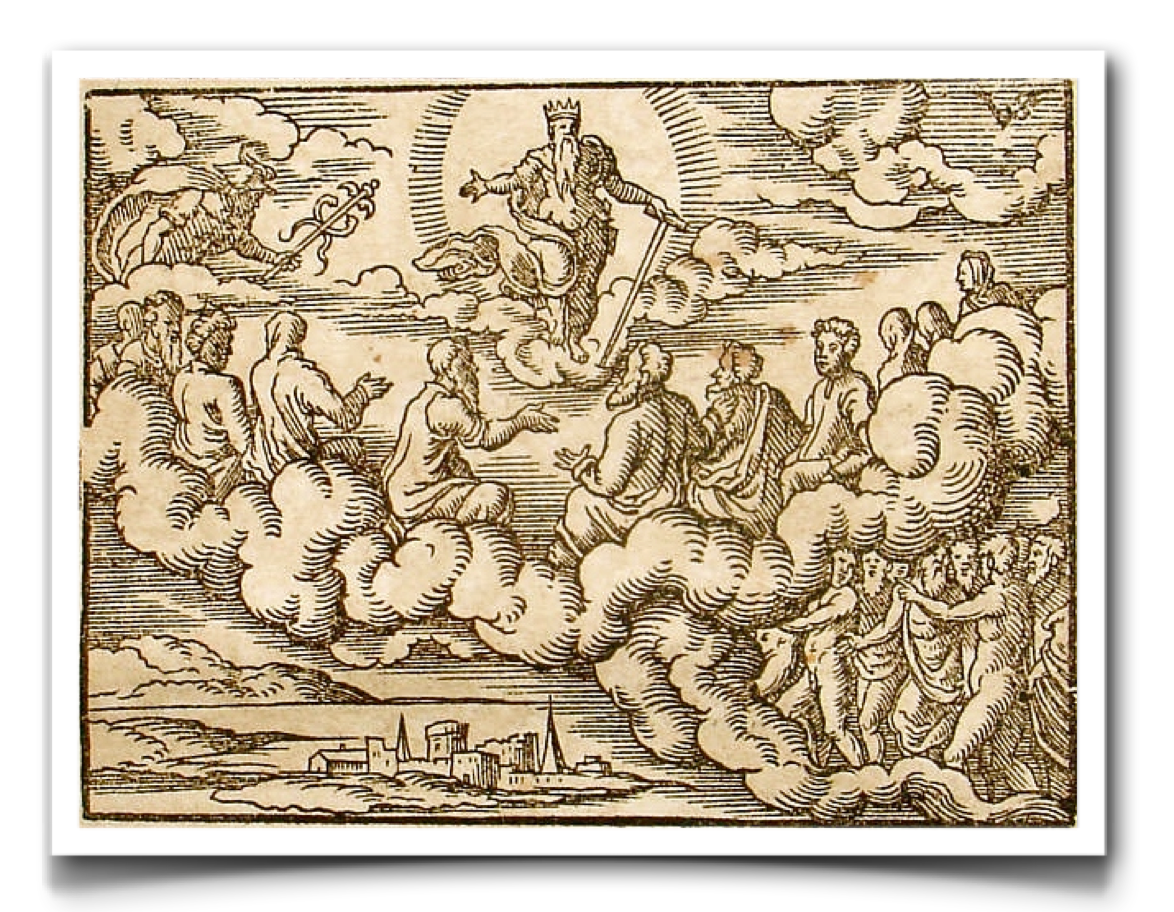
| Council of Gods before the Deluge Engraving by Virgil Solis for Ovid's Metamorphasis |
McCann points out that the key root word in Psalm 82--which is also a key word for the psalter and prophetic literature of the OT--is translated in English as "justice," and occurs four times in the short eight verses of this psalm (122-123). It is what God does to the other gods (holds them in judgment, vs. 1), accuses them of being unjust judges (vs. 2), reminds them of what true justice is (giving justice to the weak and orphan, vs. 3), and eventually, it is the key to the prayer of the psalmist (vs. 8). It is fair to say that Psalm 82 is a psalm about justice that provides us with a working definition of God's justice.
In verses 3 and 4, we hear what the gods should have been doing: caring for those people who cannot fully care for themselves and defending those who seek to exploit them. This divine council has not been meeting expectations, but instead, they "walk in darkness" (vs. 5). But instead of just being an inept cast member on a reality television show that ultimately has no consequence, these gods' negligence has caused real strife. Namely, they have caused the earth to fall apart. McCann writes that verse 5 suggests that "injustice is the undoing of creation. Where injustice exists, the world--at least the world as God intends it--falls apart. Injustice--any situation in which some people live at the expense of others--is incompatible with life as God intended it for the creation" (124).
So, in the words of Donald Trump, "You're fired." Right? Right. And that is the incredible movement of this psalm. God is so concerned with the plight of those who are oppressed, suppressed, and powerless that God will remove every power that oppresses, suppresses, and tamps them down. To participate in injustice, or even to be blind to it (as verse 5b may suggest) is to have failed to carry out the will of God. And in that case, God will fire you.
Verse 8, however, reveals another layer to Psalm 82. A short prayer follows this scene, a prayer of the psalmist popping up to call on God. To me, this movement illuminates the fact that Psalm 82 is the function of an active theological imagination--an imagination that takes the witness of the Hebrew Scriptures very seriously; that integrates them seamlessly into a mythological worldview that would not have been uncommon in the Ancient Near East. McCann focuses on the theological message of this psalm--that God's ultimate will for creation is the establishment of justice by caring for those who are in need. In class, we discussed how Jesus, as the fullest revelation of God's will, as he did work for justice in the ways outlined in verses 3 and 4, is fully divine. However, I think that this final verse has something important to say about the anthropology of the Psalms.
Mays writes that false gods are always with us: "The ancient gods have not disappeared. They have simply assumed different shapes and faces" (Preaching 151). He describes the hold that the gods of the middle-class capitalist culture. "Such gods are always with us," he writes (151), "always a part of the human predicament, the ceaseless art of our feverish genius for evading the actual divine human encounter with the Father of Jesus Christ" (Preaching 151). But here's the interesting part...at the end of Psalm 82, in that last verse, in that fervent prayer for God to come and establish justice in the places where injustice threatens to destroy creation, the psalmist reveals that he is not evading the divine human encounter...he is crying out for it.
In imagining God in the midst of the divine council, the psalmist has already begun to imagine a way in which the world may be put together in a better, more just way--a way that corresponds with God's will. Strawn points out that the psalmist's picture emphasizes the "close connections drawn throughout the psalm between heaven and earth" (82). He draws a parallel between today's boardroom or judge's chambers. Certainly, it is so easy to become disillusioned with the world today, to only see injustice, to become frustrated with the oppressive systems that rend the fabric of our communities. But Psalm 82 gives humanity a starting point--to look past the hopelessness of the situation into the reality that God stands in the midst of the unjust gods of our time and to pray the prayer that concludes the Psalm--"Rise up, O God..."
How God rises up isn't so easy to imagine. But Psalm 82 assures us that recognizing that God's mercy and power are present in these situations may just give us eyes to see what else God is doing to establish justice in our midst.
Tuesday, October 8, 2013
Psalm 69--Exegetical Thoughts
| "Save me, O God, for the waters have come up to my neck." Illustration by Jim Lockey |
$#!+ happens. Everybody hurts. Suffering isn't just a literary ploy utilized in the Psalms for dramatic emphasis--it is the stuff of real life. As humans we endure loss, grief, pain, and uncertainty. Mays points out that these experiences are inherent in the human condition (111). But what else does Psalm 69 teach us is inherent in the human condition?
Because we cannot read a specific historical figure or context out of Psalm 69, it serves as a prayer for many circumstances, circumstances that are as relevant today as they might have been in ancient Israel: alienation from society, friends and family because of one's faith; being falsely accused and accept guilt; feeling isolated and alone in human community. And so, we turn to God. Though Psalm 69 speaks of alienation, it is not speak alienation to us. Instead it speaks of the human ability to reach out to Creator God in times of distress.
We have the capacity for suffering. God has the capacity to hear our laments. But it's more than that. Mays writes, "Nothing that comes to any human being--no tears, no depth, no anguish--is beyond and without the kingdom of God" (Preaching 115). Or, as Paul riffs on Psalm 69, there is nothing that can separate us from the love of God (Rom. 8: 39). The laments also show us that humans have the capacity for praise in the midst of difficulty. It's easy to read the praise turns in the laments and to assume that some major break has occurred in the poem, that some radical change in circumstance has taken place, that God has waved a magic wand to rescue the psalmist from waters that are up to his neck. Rather, I read this shift of praise as another expression of universal and essential humanity--that we can be comforted in the most dire of circumstances by the knowledge of God's sovereign reign. As Mays writes, "We are shown who we are when we pray" (116), and the fundamental message of Psalm 69 is that no matter the circumstances, we are still God's. This affirmation of faith doesn't cure our circumstances, but it does help us to understand that though difficulty may characterize our human condition, these conditions are still embedded in God's steadfast love and abundant mercy (Ps. 69: 16).
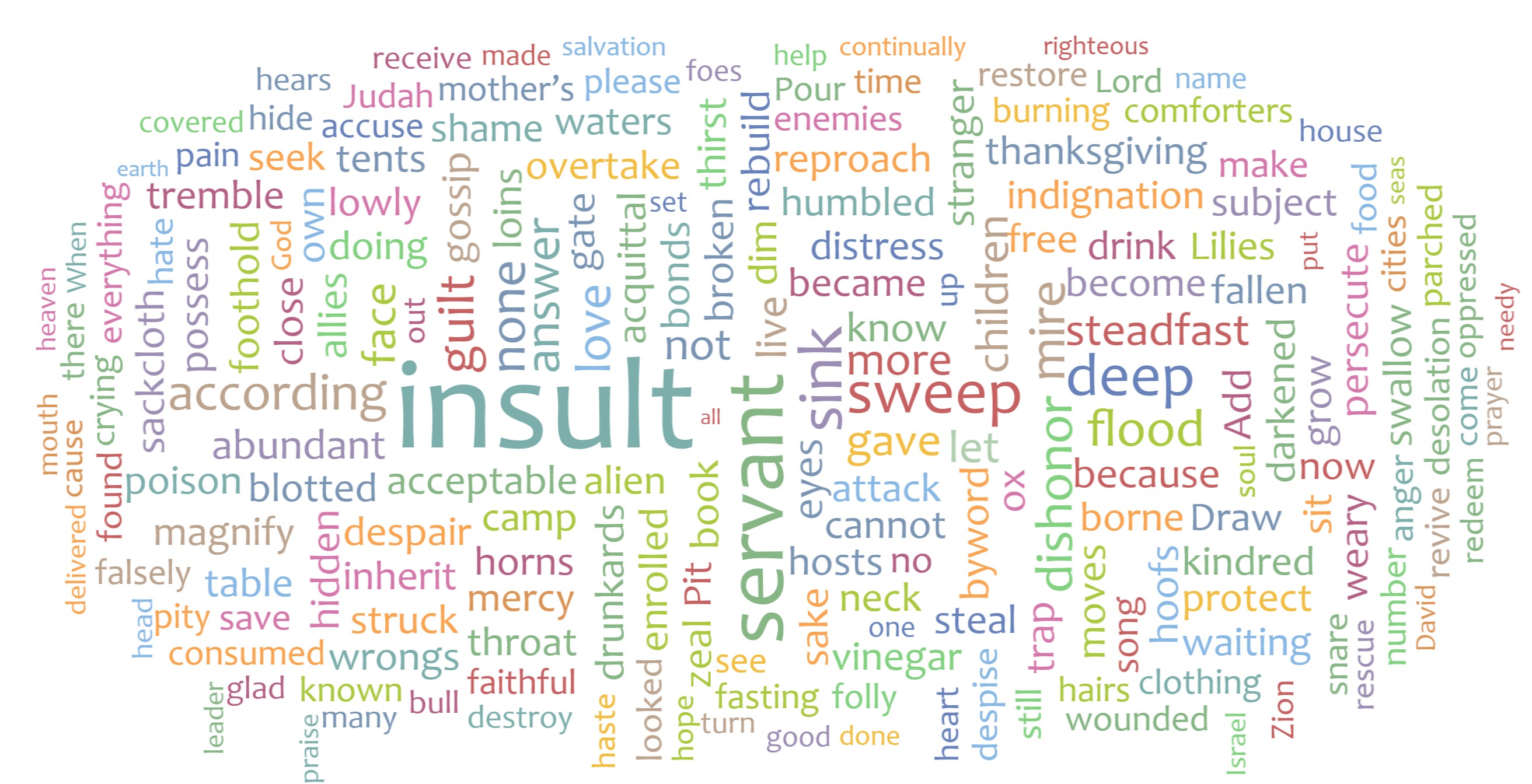
In the first 12 verses of Psalm 69, the psalmist focuses on the situation at hand, looking especially at the wounds inflicted by his fellow human. These experiences are characterized especially by reproach and insult (both Heb. herpa). But when the psalmist turns to examine the character of God in verse 13, it is a different story. In reflecting on the steadfast love and abundant mercy of the Lord, the psalmist cries for a nearness of the Lord--not just to comfort the psalmist, but to enact justice upon the enemies (vss. 22-29). In that turn to praise, the psalmist displays the human capacity to look beyond the present circumstances and to locate a mental space in which it is possible to sing God's praises. McCann characterizes this as an "eschatalogical perspective" (NIB Commentary 953). A movement to praise doesn't mean that everything is perfect. What it means is that the interaction with the divine character has enabled the human to see beyond the present circumstances to the incredible fact that God's graciousness pervades even the moment of crisis. This is good news, indeed.
| "Psalm 69: Sinking Not Sunk" by Melani Pyke |
Additionally, I think you'd need to touch on the NT interpretations of Psalm 69 (See Limburg 230), with the understanding that this use of Psalm 69 affirms the deep humanity of Jesus, in that he identified with the suffering and praise present in the psalm, but also acted in an exemplary manner in his faithful relationship with God through that suffering.
Thursday, September 26, 2013
Psalm 13--Worship Resources
Music:
UMH: Psalter for Psalm 13, #746
UMH: Be Still My Soul, #534
UMH: Pass Me Not, O Gentle Savior, $351
FWS: How Long, O Lord, #2209
W&S: Falling on My Knees, #3099
W&S: Bidden, Unbidden, 3019
Psalm 13 (How Long O Lord)--Brian Doerksen
Psalm 13--Nate Hale
How Long (feat. Bethany John)--The Psalms Project (Rel. 12/6/2013)
Der 13. Psalm "Herr, wie lange" Op. 27--Johannes Brahms
I Believe--Mark Miller
“I believe in the sun,
even when it is not shining.
I believe in love,
even when I do not feel it.
I believe in God,
even when God is silent.”
This statement of faith was scrawled on a cellar wall in Cologne by a Jewish person hiding from teh Nazi Gestapo during WWII. American soldiers discovered it below a Star of David when searching the bombed house. This poem is the text for Mark Miller's anthem, "I Believe."
Video
How Long from The Inspire Collective on Vimeo.
Depression Conversation Starters:
"Depression 'second leading cause of disability worldwide'" - Medical News Today
UMH: Psalter for Psalm 13, #746
UMH: Be Still My Soul, #534
UMH: Pass Me Not, O Gentle Savior, $351
FWS: How Long, O Lord, #2209
W&S: Falling on My Knees, #3099
W&S: Bidden, Unbidden, 3019
Psalm 13 (How Long O Lord)--Brian Doerksen
Psalm 13--Nate Hale
How Long (feat. Bethany John)--The Psalms Project (Rel. 12/6/2013)
Der 13. Psalm "Herr, wie lange" Op. 27--Johannes Brahms
I Believe--Mark Miller
“I believe in the sun,
even when it is not shining.
I believe in love,
even when I do not feel it.
I believe in God,
even when God is silent.”
This statement of faith was scrawled on a cellar wall in Cologne by a Jewish person hiding from teh Nazi Gestapo during WWII. American soldiers discovered it below a Star of David when searching the bombed house. This poem is the text for Mark Miller's anthem, "I Believe."
Video
How Long from The Inspire Collective on Vimeo.
Depression Conversation Starters:
![]() |
| From "Adventures in Depression, Part Two" Hyperbole and a Half |
Depression Basics -- Halfofus.com
Tuesday, September 24, 2013
Psalm 13--Exegetical Thoughts
- Before I read the commentaries for the lament psalms, I hadn't realized that a lament is actually a "call for help" (Limburg 38). Honestly? I thought a lament was simply a complaint, a wailing, a plaintive cry. And while a complaint is certainly a part of a lament psalm, it's not the whole story--at least not in Psalm 13. Understanding the genre of lament as a call for help helps the reader to understand that Psalm 13 is a prayer that leads somewhere, both in the moment of prayer and in studying it. It offers both comfort and theological instruction about the relationship between God and humanity.
- Scholars refer to the three characters of the lament psalms--God, self, and enemy-- in terms of theology, psychology, and sociology (see McCann 86, Mays 78, Strawn 71). In the lament, it becomes clear that something in these relationships has gone awry, something is troubling. In today's world, we tend to treat each of these areas (theology, psychology, and sociology) as their own distinct spheres, as if they don't intersect at all. What Psalm 13 points out is that these are deeply connected, and if there is an imbalance in any of them, there is an imbalance in all--we lose our identity as people of God, as ourselves, and as a member of a human community. We "sleep the sleep of death" (vs. 3).
- Though there is a radical turn in verses 5-6, I think it's important to point out the address of the lament: directly to God. This gesture lets us know that it's OK to come to God with our worst and at our worst. Crying out to God isn't a crime. But something about it seems strange to us. As McCann points out, there is a pointed avoidance of lament psalms in our culture (85-86), as if we cannot make sense of them. But I think the fact that texts that border of blasphemous are considered to be a part of our cannon is important. Being honest about our circumstances is just a part of being a faithful person, warts, complaints, and all (Mays 78, Limburg 38).
- I want to focus in on verse 2a: How long must I bear pain in my soul, and have sorrow in my heart all day long? When I read this, I am immediately transported to the time I spent answering a suicide hotline. Whether the voices were overflowing with pain or numbed by their struggles with it, their cries gave voice to the uncertainty of their plight, of knowing they were in the midst of suffering, but not knowing how begin see anything beyond it. It was like a tunnel vision of suffering. McCann's literal reading of the Hebrew here highlights the isolation these callers voiced: "How long must I hold counsel in my soul" and "sorrow in my heart" (91). Theirs were literally calls for help. They saw no way but the way of death before them. They needed light in their eyes, a way to see beyond their circumstances. One of the techniques we were instructed to use was to ask what coping mechanisms for difficult feelings had worked for callers in the past. Then, we would explore with them how those very skills might be available to them now.
- This is how I read the turn in verses 5-6: a remembrance of God's faithfulness in the past illuminates their future. So often, we want our answers to appear out of the blue, illuminating a bright new future, divorced, somehow, from the suffering we have felt. Mays eloquently lays out how this thinking is incorrect, and how the "agony and the ecstasy belong together as the secret of our identity" (Preaching 168). The lightening of the eyes that occurs is not into a new reality, but is in a remembered reality of a faithful God. And in the remembrance, a new way of living emerges. Perhaps Psalm 13 is a lament of one who has taken the wrong "way" (Ps. 1). And perhaps it's a lament that helps the sufferer find her way back to he way of the righteous after all.
Friday, September 13, 2013
Psalm 1--Exegetical Thoughts
- Psalm 1 functions as a theological introduction to the Psalms (McCann 25). Its introduction of the themes of "happiness," righteousness, and wickedness helps to orient the reader of Psalms in these concepts. Strawn points especially to the nearly archetypal characterization of the righteous versus the wicked, and its inherent urging to follow the path of the righteous (53). However, the most important theological function of Psalm 1 is to emphasize the importance of torah--or instruction. McCann would point out that he Psalms themselves function as torah (see 25-40). As a theological introduction to the Psalms, Psalm 1 lets the reader know that "the way" continues by reading on. Emphasizing this aspect of Psalm 1 would be especially important in the context of a Bible study on the Psalms, or in a larger consideration of the book of Psalms. For preaching purposes, though, I think it's important to focus on "the world within Psalm 1" (Strawn 51).
- It had never occurred to me before that Psalm 1 is a beatitude (Mays 40). First of all, in today's culture, I think that beatitudes that describe a faith-oriented way of life make a counter-cultural statement. As McCann points out, Psalm 1 actuall points out that the wicked are actually those who think of themselves as, "self-instructed, self-directed, and self-ruled" (38). American culture so proudly affirms these attributes that the opening line of Psalm 1 could be read as a radical statement: happiness comes from openness to instruction and obedience to that instruction. Happiness from obedience? From discipline? Boy...THAT is counter-cultural stuf.
- Of course, when reminded of beatitudes, one cannot help but think of Matthew 5: 1-12. So, how does it compare? Like Matthew 5's beatitudes, Psalm 1 describes the ideal faithful individual. While Matthew gives us some pretty solid examples of how this faithfulness is carried out, Psalm 1 only gives us one: she makes constantly available to God's instruction. Then, the beatitude veers into metaphor, doing more to support this assertion than to flesh it out. Psalm 1 is not as explicit in its description of acts of justice and righteousness, but seems to assume that acts of justice (vs. 5a) and righteousness (vs. 5b, 6) will flow naturally from the one practice of availability to torah.
- For me, the most exegetically compelling part of Psalm 1 is the relationship of the wicked and the righteous. What Strawn characterizes as simple dualism (53), I see as a much more complicated matter. In fully characterizing the righteous and the wicked, most exegetes look to the larger use of these words on the psalmic vocabulary or in the Hebrew canon. Mays describes the three main roles of the wicked in the psalms as characters drawn in contrast to the righteous as a warning, as those who hurt others, and as those who threaten the faithful (43). However, he goes on to say, "In all their roles, the wicked represent the incongruence in the human world between the will of God and the will of human beings" (43). McCann also sketches the wicked as those who, through misguided autonomy, cut themselves off from their source of life (39). However, a close reading reveals that casting these journeys of the righteous and the wicked as divergent to the point of life or death may be overstating things. The text does not use language that refers to the actual state of being alive or to physical death. As McCann pointed out in class, "perish" in verse 6b is actually better translated as "leads to ruin" (9/16/13). And I think it is worth pointing out that it is not the wicked themselves that perish, but their way. It begs the question...what happens then?
- I think this is an important interpretive point. Mays encourages us to move beyond a reading of proud legalism in Psalm 1, and in doing so, he points out our error in wanting always "to begin over and over with God's forgiveness and saving work, because we are fascinated with our sin" (Preaching 162). Humanity will always be fascinated with our sins, will always be distracted from the way of righteousness onto the way of wickedness. But what I believe the last line of Psalm 1 tells us is not that you're wicked and then you die. Rather, I believe that it indicates that when that way runs out--and it will run out: the money will no longer satisfy, the possessions won't sustain, the independence will become lonely, and the misplaced values will prove empty--there is always the path of the righteousness that extends before us. We may have to retrace our steps a bit to get to it, but it's there. The way of the wicked will perish. But God is not dooming the wicked to eternally wander out of God's presence.
- The gracious aspect of the Psalm is illuminated in this reading: torah is always available to us. Though we might not always make use of it, it is there. We walk in the way of the righteous when we turn to it; in the way of the wicked when we don't. And I believe that a picture of the simultaneously righteous and wicked is a much more relevant (and gracious) reading of the text than of the dualistic understanding of the two.
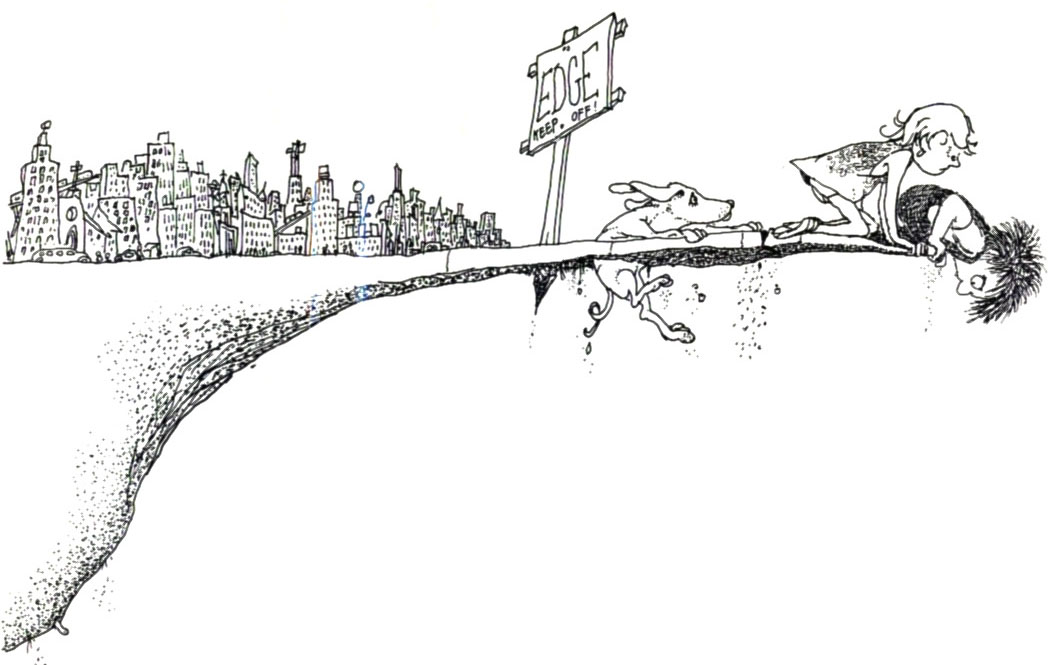
Illustration by Shel Silverstein "Where the Sidewalk Ends"
Subscribe to:
Posts (Atom)