Music:
UMH: Amazing Grace, #378
UMH: Grace Greater Than Our Sin, #365
W&S: Confession (Musical Response), #3138
FWS: You Are My Hiding Place, #2055
While I Keep Silence--Wright
Psalm 32--Mike & Liz Mumford
You are my Hiding Place
Pretty much any Kyrie would be appropriate, too.
Prayers of Confession and Pardon:
W&S: #84-97
BOW: #474-494
Video:
Songs of Deliverance from Biltmore Baptist Church on Vimeo.
Sermon Illustrations:
10 Risks Happy People Take: http://www.marcandangel.com/2013/10/20/10-risks-happy-people-take-every-day/
Many of these "risks" have to do with opening up about being imperfect, off-track, and being willing to grow. Sounds like what it means to open up to God in confession. Could see using this list in a sermon series on beatitudes: "Happy are those..."
Nelson Mandella's ability to forgive: http://newday.blogs.cnn.com/2013/12/08/finding-forgiveness/?sr=sharebar_facebook
A video on Nelson Mandella's forgiveness of those who imprisoned him. Conversation turns to how to begin the process of forgiveness. Clincial Psychologist discusses changing perception--confession and assurance from God can help us do this. Biblical scholar Brent Strawn discusses Psalms, especially in dealing with enemies (at 6:40). Conversation with God keeps our own sin and sin of others from taking over our entire lives.
Missional Connection:
Freeing Slaves to Rebuild Lives: http://www.umcor.org/UMCOR/Resources/News-Stories/2013/December/1203freeingslavestorebuildlives
Some of our confession may need to be on a societal level. In the case of human-trafficking, I think many of us would prefer to keep our silence on the matter--to pretend that this issue just didn't exist. But in acknowledging and talking about this issue, we begin to confess the sins of our world, even if they are not our own personal sins, and can participate in sharing God's grace in these darkened paths.
Showing posts with label Happy is. Show all posts
Showing posts with label Happy is. Show all posts
Saturday, November 9, 2013

Thursday, November 7, 2013
Psalm 32--Exegetical Thoughts
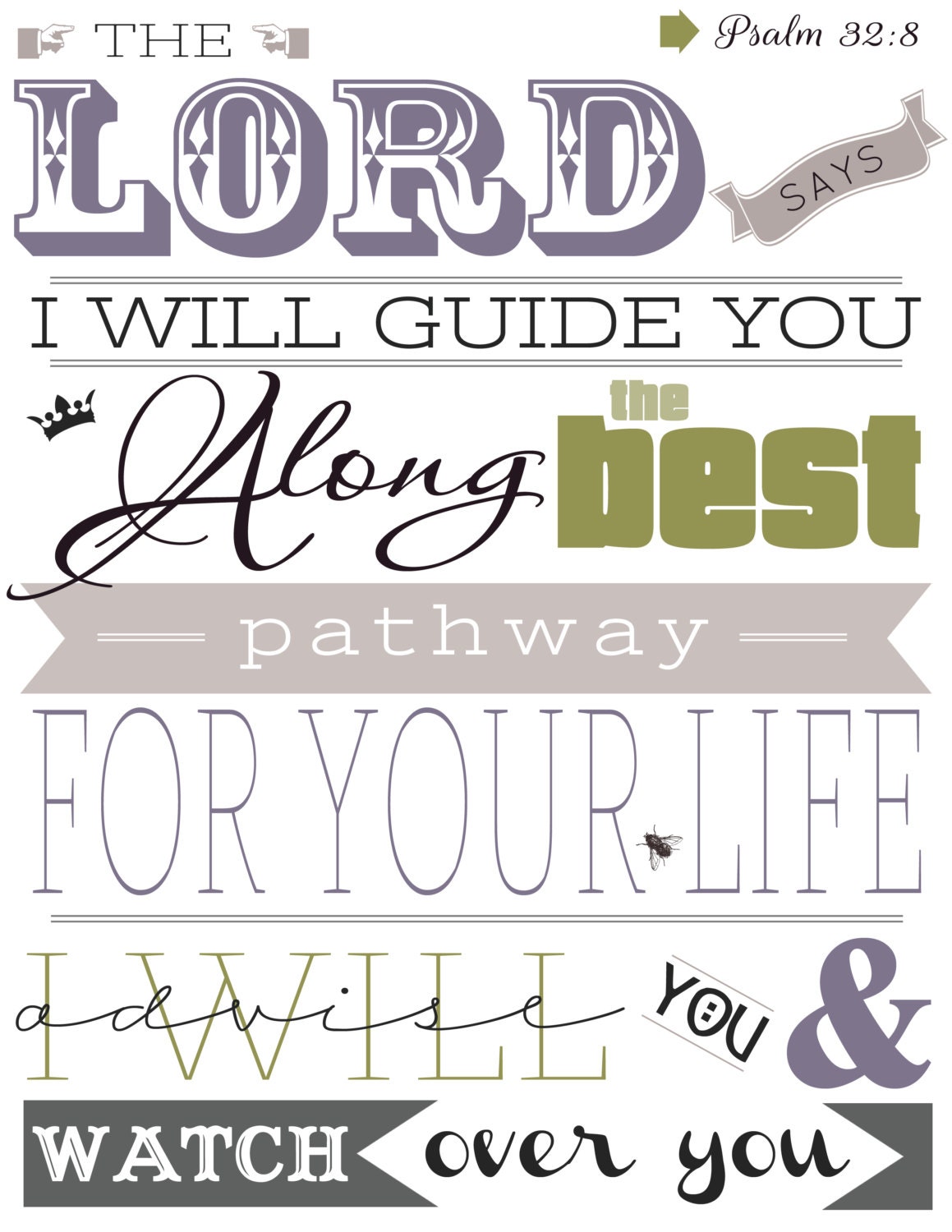 |
| Custom Typography of Psalm 32 by MulliganStudio |
First of all, it's introductory words, "Happy are those..." echo those first words of the psalter. This is the first time we have seen this formula for the beatitude since Psalm 1, though we will see it again in Psalms 41, 112, 119, 127, and 128. Certainly this introduction indicates that there is something worth knowing about what's in this psalm. The simple fact that it starts with a beatitude leads us to believe that what follows might just show us how to attain that happiness ourselves.
Additionally, Psalm 32 echoes other key words of Psalm 1, especially torah (translated as "instruct" in vs. 8), "the way" (vs. 8), "wicked" (vs. 10), and "righteous" (vs. 11.) For other key word connections, see McCann 110.
In my earlier treatment of Psalm 1, I interpreted the ending of the path of the wicked not as a death, but as a way to acknowledge the grace of God's instruction--that it is always available to us, and we can always turn toward it from our paths of unrighteousness. As humans, we're just going to follow some wicked paths. The trick of those blessed righteous is to find our way back to the path of the faithful by looking for God's instruction, even in the midst of our wickedness.
And this is precisely the move that Psalm 32 makes. The first verse lets us know that even though one is "happy" or "blessed," it does not mean that s/he is without blemish. There will be transgression. So, what distinguishes the righteous from the wicked, then? Knowles says that it is the experience of God's forgiveness that plucks us from paths of wickedness to paths of righteousness again.

But in verse 5, the psalmist brings the sin before the Lord. Knowles points out that the psalm itself does not reveal the content of the confession, but this serves to highlight the Lord's immediate forgiveness, regardless of the content of the confession. The mere movement to communication and honesty with God elicits God's gracious response (133). Verses 6-7 function as personal witness, encouraging others to turn to God in their times of difficulty (McCann 110). The circumstances that our human imperfection creates are dire, but by turning to God, a safe place is found in the midst of disaster.
Verses 8-11 most closely resemble Psalm 1, with the clear focus on torah or instruction in "the way." Again, instruction is offered, but not forced. The psalmist states that though it may not be the best option to forego torah, it is still an option (vs. 9). That said, by confessing to God, humans display their trust in God. And trusting in God also helps us to see the hesed that is always available to us. In these ways, Psalm 32 offers a fuller picture of the instruction promised in Psalm 1, and shows us just how to locate "the way" again when we have wandered from the path of the righteous.
One instructional moment for me in Psalm 32 is the use of different words for sin in verses 1-2. Limburg points out that these words represent major themes in the OT (103). I think it's important to recognize that there are many ways to wander from the path of the righteous, and that in confession, it also helps to understand how one has strayed. The four words for sin are:
- transgression--a rebellion
- sin--missing the target
- iniquity--being bent, twisted, or crooked
- deceit--treacherous or unreliable (Limberg 103)
So often, we think about sin in a singular sense, as if there is only one way to stray from God's intentions for the world. Psalm 32 helps us to understand that there are many ways to get off-track, with some of them requiring less conscious action than we might like to believe.
Psalm 32 draws attention to the fact that we will slip up, we will wander from the path of the righteous. We're only human. But it also draws attention to the fact that God is always available to hear our cries of uncertainty, of apology, of confusion during these times of wandering. And it is from voicing these cries that we are also able to find our voices again to be able to"shout for joy" (vs. 11).
Friday, September 13, 2013
Psalm 1--Worship Resources
Music:
UMH: Psalter for Psalm 1, #738
UMH: #601 "Thy Word Is a Lamp"
Faith We Sing: "I Will Enter His Gates"
"Blessed Is the Man" Psalm 1:1-2, The Psalms Project
"He Is Like a Tree" Psalm 1:3
Video:
Psalm 1 - Sacred Guardian by Elijah Aaron
Psalm 1 - Sacred Guardian by Elijah Aaron
Prayer for Illumination from Worship & Song
Eternal God,
in the reading of the Scripture, may your Word be heard;
in the meditations of our hearts, may your Word be known;
and in the faithfulness of our lives, may your Word be shown. Amen.
Collect based on Psalm 1:
God of torah,
who invites all to follow the way--
the way that leads to life,
the way that leads to peace,
the way that leads each of us to this very moment--
watch over our learning
so that we may be more than educated,
more than well-read,
more than simply proficient;
watch over our learning
so that we may become
students of your instruction
students who delight in your instruction
as we continue in the way.
We pray this in the name of Jesus Christ,
our trailblazer and our teacher.
Amen.
Articles and Illustrations:
"10 Decisions That Will Make You Happier and Healtier" Huffingtonpost.com
"10 Things Happy People Do Differently" Psychologytoday.com
"What the Happiest People Know for Sure" Oprah.com
"Atheism as ultimate white privilege" patheos.com
Psalm 1--Exegetical Thoughts

- Psalm 1 functions as a theological introduction to the Psalms (McCann 25). Its introduction of the themes of "happiness," righteousness, and wickedness helps to orient the reader of Psalms in these concepts. Strawn points especially to the nearly archetypal characterization of the righteous versus the wicked, and its inherent urging to follow the path of the righteous (53). However, the most important theological function of Psalm 1 is to emphasize the importance of torah--or instruction. McCann would point out that he Psalms themselves function as torah (see 25-40). As a theological introduction to the Psalms, Psalm 1 lets the reader know that "the way" continues by reading on. Emphasizing this aspect of Psalm 1 would be especially important in the context of a Bible study on the Psalms, or in a larger consideration of the book of Psalms. For preaching purposes, though, I think it's important to focus on "the world within Psalm 1" (Strawn 51).
- It had never occurred to me before that Psalm 1 is a beatitude (Mays 40). First of all, in today's culture, I think that beatitudes that describe a faith-oriented way of life make a counter-cultural statement. As McCann points out, Psalm 1 actuall points out that the wicked are actually those who think of themselves as, "self-instructed, self-directed, and self-ruled" (38). American culture so proudly affirms these attributes that the opening line of Psalm 1 could be read as a radical statement: happiness comes from openness to instruction and obedience to that instruction. Happiness from obedience? From discipline? Boy...THAT is counter-cultural stuf.
- Of course, when reminded of beatitudes, one cannot help but think of Matthew 5: 1-12. So, how does it compare? Like Matthew 5's beatitudes, Psalm 1 describes the ideal faithful individual. While Matthew gives us some pretty solid examples of how this faithfulness is carried out, Psalm 1 only gives us one: she makes constantly available to God's instruction. Then, the beatitude veers into metaphor, doing more to support this assertion than to flesh it out. Psalm 1 is not as explicit in its description of acts of justice and righteousness, but seems to assume that acts of justice (vs. 5a) and righteousness (vs. 5b, 6) will flow naturally from the one practice of availability to torah.
- For me, the most exegetically compelling part of Psalm 1 is the relationship of the wicked and the righteous. What Strawn characterizes as simple dualism (53), I see as a much more complicated matter. In fully characterizing the righteous and the wicked, most exegetes look to the larger use of these words on the psalmic vocabulary or in the Hebrew canon. Mays describes the three main roles of the wicked in the psalms as characters drawn in contrast to the righteous as a warning, as those who hurt others, and as those who threaten the faithful (43). However, he goes on to say, "In all their roles, the wicked represent the incongruence in the human world between the will of God and the will of human beings" (43). McCann also sketches the wicked as those who, through misguided autonomy, cut themselves off from their source of life (39). However, a close reading reveals that casting these journeys of the righteous and the wicked as divergent to the point of life or death may be overstating things. The text does not use language that refers to the actual state of being alive or to physical death. As McCann pointed out in class, "perish" in verse 6b is actually better translated as "leads to ruin" (9/16/13). And I think it is worth pointing out that it is not the wicked themselves that perish, but their way. It begs the question...what happens then?
- I think this is an important interpretive point. Mays encourages us to move beyond a reading of proud legalism in Psalm 1, and in doing so, he points out our error in wanting always "to begin over and over with God's forgiveness and saving work, because we are fascinated with our sin" (Preaching 162). Humanity will always be fascinated with our sins, will always be distracted from the way of righteousness onto the way of wickedness. But what I believe the last line of Psalm 1 tells us is not that you're wicked and then you die. Rather, I believe that it indicates that when that way runs out--and it will run out: the money will no longer satisfy, the possessions won't sustain, the independence will become lonely, and the misplaced values will prove empty--there is always the path of the righteousness that extends before us. We may have to retrace our steps a bit to get to it, but it's there. The way of the wicked will perish. But God is not dooming the wicked to eternally wander out of God's presence.
- The gracious aspect of the Psalm is illuminated in this reading: torah is always available to us. Though we might not always make use of it, it is there. We walk in the way of the righteous when we turn to it; in the way of the wicked when we don't. And I believe that a picture of the simultaneously righteous and wicked is a much more relevant (and gracious) reading of the text than of the dualistic understanding of the two.
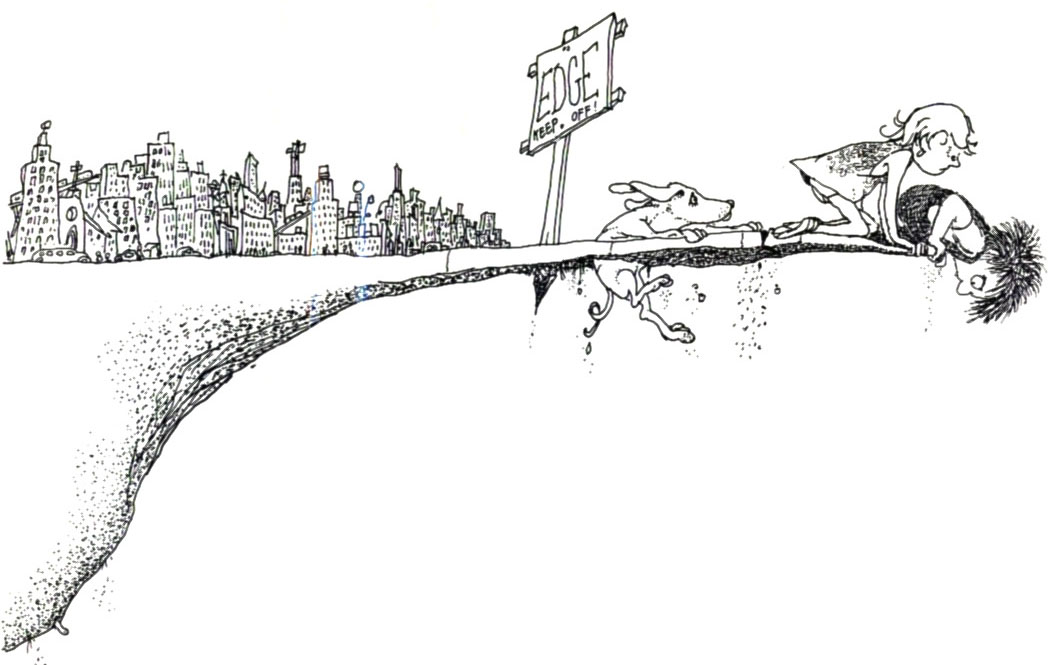
Illustration by Shel Silverstein "Where the Sidewalk Ends"
Subscribe to:
Posts (Atom)